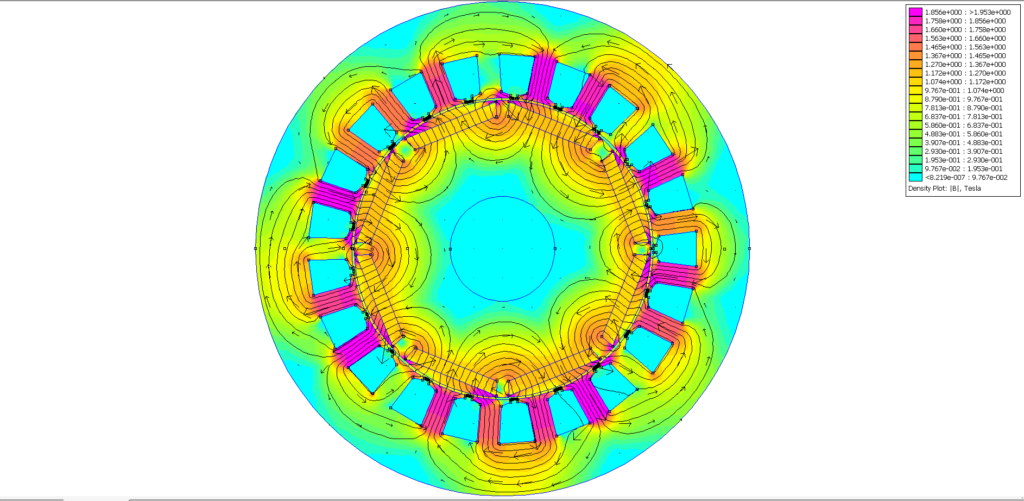
Modeling and Simulation Of BLDC Motors With FEM Software
Project Overview
A comprehensive engineering research project presenting a two-stage redesign of a brushless direct-current (BLDC) motor. This work systematically addresses the two dominant torque non-idealities governing fractional-slot concentrated-winding (FSCW) machines: mechanical cogging torque and electromagnetically-induced torque ripple.
The Engineering Challenge
The baseline 24-slot/8-pole integer-slot motor suffered from a severe peak-to-peak cogging torque of 33.21 N·m, rendering it structurally incompatible with precision motion applications. The challenge was to geometrically eliminate this detent torque, and subsequently resolve the complex localized magnetic saturation that emerges when altering the core topology.
Methodology & Execution
-
Topological Redesign: Transitioned the core to a 21-slot/8-pole FSCW topology, significantly raising the Least Common Multiple (LCM) from 24 to 168. This geometric shift structurally crushed the cogging torque amplitude by a massive factor of 18.8x.
-
Engineering Trade-offs: Transparently documented the mechanical compromise of Unbalanced Magnetic Pull (UMP). Acknowledged that the new Greatest Common Divisor (GCD) of 1 precludes radial force cancellation, establishing this as a critical parameter for subsequent bearing and rotor-dynamic design.
-
High-Fidelity Finite Element Method (FEM) Analysis: Deployed rigorous 2D planar magnetostatic FEM simulations across a $0.0226292m^2 domain to accurately capture the highly nonlinear B-H saturation characteristics of the stator steel. A highly dense, adaptively refined mesh of 102,757 nodes and 205,355 triangular elements was constructed. This advanced FEM analysis was the cornerstone of the project; it successfully exposed an invisible pathology—a catastrophic M-shaped torque collapse down to -9.59 N.m driven by severe spatial-harmonic stator saturation under static excitation.
-
Dynamic Control Strategy (FOC): To counteract the harmonic saturation revealed by the FEM solver, a pure Sinusoidal Field-Oriented Control (FOC) strategy was implemented. By applying an empirically tuned 63-degree electrical advance angle, the stator MMF was continuously realigned with the rotor flux, eliminating the negative-torque excursions entirely and restoring a strictly positive waveform.
-
Comprehensive Efficiency Profiling: Evaluated the motor at a rated speed of 1500 rpm using the generalized Steinmetz equation. Factored in copper, core, and internal leakage losses, alongside estimated mechanical friction and windage allowances, to derive a realistic comprehensive shaft efficiency rather than purely theoretical electromagnetic figures.
-
Academic Rigor: Synthesized a robust literature review by critically filtering and integrating insights from 10 verified open-access IEEE publications, perfectly framing the unique research gap regarding the synchronized application of LCM optimization and FOC phase angle adjustments in highly asymmetric configurations.
Key Results
-
Suppressed peak-to-peak cogging torque from 33.21 N·m to just 1.76 N·m.
-
Stabilized the net average electromagnetic torque at 25.95 N·m.
-
Significantly mitigated dynamic torque ripple down to 20.5%.
-
Achieved a highly optimized comprehensive shaft efficiency of 94.4% while delivering 3994 W of useful mechanical output power.
Tools & Technologies
-
FEMM 4.2: For executing highly granular 2D magnetostatic finite element analysis and profiling localized nonlinear magnetic saturation.
-
LaTeX (Overleaf): For structuring, mathematically typesetting, and formatting the research paper strictly to standard IEEEtran academic guidelines.
-
Motor-CAD Concepts: For accurately framing mechanical loss boundaries and operational efficiency parameters.
-
NotebookLM & AI Tools: Employed via advanced RAG (Retrieval-Augmented Generation) methodologies to securely analyze complex academic papers.